Click your state to see economics by utility
State colors use weighted avg across utilities · hover for per-utility breakdown
Plug-In Solar Legislation Tracker
Lawmakers in 33+ states have introduced bills to legalize plug-in solar — and Utah, Maine, and Virginia have already enacted laws. Here are the states leading the way.
All current bills cap plug-in solar at 1,200 watts and require UL certification for safety. Track all states at Solar Rights Alliance | WRI policy overview
What Is Balcony Solar?
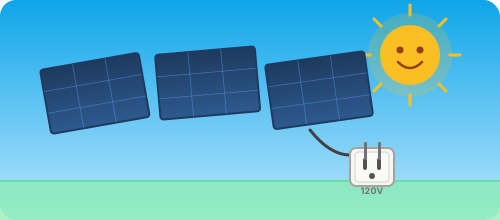
Balcony solar — also called plug-in solar, portable solar, or microinverter solar — is a small photovoltaic system (typically 1 to 4 panels) that plugs directly into a standard 120-volt household outlet. Unlike traditional rooftop solar, balcony solar requires no roof access, no electrical panel modifications, and no professional installation in most cases. Systems are capped at 1,200 watts by all current U.S. legislation and must carry UL 3700 safety certification.
How Does Plug-In Solar Work?
Each panel includes a built-in microinverter that converts DC electricity from the solar cells into AC electricity compatible with your home wiring. When you plug the panel into a wall outlet, the generated power flows into your home's circuits and offsets whatever appliances are consuming electricity at that moment. Your utility meter slows down (or spins backward, depending on your meter type), reducing your electricity bill. All UL-certified panels include anti-islanding protection that automatically shuts the system down during a power outage, protecting utility line workers.
Who Can Use Balcony Solar Panels?
Plug-in solar is designed for people who cannot install traditional rooftop systems: apartment renters, condo owners, townhouse residents, and anyone with limited roof access or HOA restrictions. Panels can be placed on balconies, patios, porches, window ledges, fences, or in yards. Because systems are classified as personal property (not permanent fixtures) under most new state laws, landlords and HOAs generally cannot prohibit their use.
Is Balcony Solar Legal in the United States?
Legality is changing rapidly. Utah became the first state to pass a comprehensive plug-in solar law (HB 340) in March 2025, with unanimous bipartisan support. Maine followed with LD 1730 in April 2026, and Virginia became the third state on April 22, 2026, when the General Assembly accepted Gov. Spanberger's technical amendments to HB 395 / SB 250. Colorado (HB 26-1007, up to 1,920W) and Maryland (HB 1532, the Utility RELIEF Act) have both passed legislation through both chambers and are awaiting governors' signatures. New York's Senate unanimously passed the SUNNY Act 62-0. As of April 2026, lawmakers in 33+ states and Washington D.C. have introduced bills to legalize plug-in solar devices. Most current legislation caps systems at 1,200 watts (Colorado allows up to 1,920W) and requires UL 3700 safety certification.
How Much Can You Save with Plug-In Solar?
Savings depend on four factors: your local electricity rate, average peak sun hours, system size, and panel tilt angle. A typical 1,200W system costing around $2,000 can produce 1,200 to 2,000 kWh per year depending on location. In states with high electricity rates (like Connecticut at $0.30/kWh), payback can be under 4 years. In states with lower rates and moderate sun, payback may take 6 to 8 years. Over a 20-year panel lifespan, net savings typically range from $3,000 to $8,000. Use the calculator above to estimate your specific savings based on your state, utility, and setup.
How This Calculator Works
This calculator uses state-level peak sun hour data combined with your utility's electricity rate to estimate annual production and savings. Tilt angle adjustments account for the reduced efficiency of non-optimal panel angles (common on balcony railings). For more precise results, enter your zip code to pull location-specific data from the NREL PVWatts API, the same tool used by professional solar installers. Utility rate data comes from the U.S. Energy Information Administration (EIA).
State-by-State Plug-In Solar Legislation
| State | Bill | Status | Max Watts | Utility Approval |
|---|---|---|---|---|
| Utah | HB 340 | Signed into Law | 1,200W | No interconnection application required |
| Maine | LD 1730 | Signed into Law | 1,200W | No notification required for systems 420W or under; utility notification within 30 days for 421-1200W |
| Virginia | HB 395 / SB 250 | Signed into Law | 1,200W | Notification only — no fees or prior approval |
| Colorado | HB 26-1007 | Passed Legislature | 1,920W | No utility approval needed before installation |
| Maryland | HB 1532 (Utility RELIEF Act) | Passed Legislature | 1,200W | Streamlined — no separate interconnection agreement |
| New York | SUNNY Act (S 8512B / A 9111B) | Introduced | 1,200W | Would prohibit utilities from requiring approval or fees |
| Illinois | SB 3104 / HB 4524 | Introduced | 1,200W | Utility notification (not approval) required within 30 days |
Explore by State
States with active plug-in solar legislation — click to see state-specific savings estimates.
Data Sources
- Solar production data: NREL PVWatts Calculator
- Utility rates: EIA Form 861 (2023)
- Legislation tracking: Solar Rights Alliance, World Resources Institute
- UL 3700 safety standard: Underwriters Laboratories
Last updated: April 11, 2026. Legislation status is tracked as bills advance — check individual bill links for the most current status.
Free & open source
More Free Electrification Tools
Rebate calculators, heat pump sizing tools, and more — all free for homeowners.
Keep going
More free tools that pair with this one.
See when each appliance is likely to fail so you can plan the swap before an emergency.
See whether your panel can handle a heat pump, HPWH, or EV charger before any big upgrade.
See whether a TOU or EV rate plan saves more once you add a heat pump or charger.